
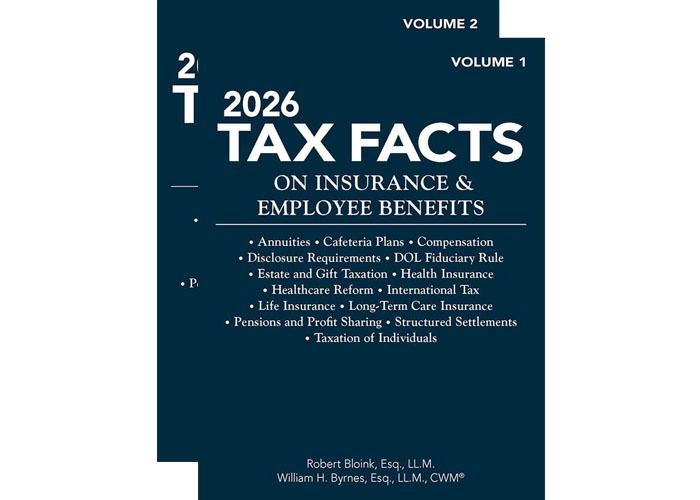
2026 Tax Facts on Insurance & Employee Benefits (Volumes 1 & 2)
Tax Facts on Insurance & Employee Benefits is your complete source for tax information that relates to these two critical business and financial planning areas. With thousands of easy-to-use Q&As addressing key topics, Tax Facts equips advisors with the knowledge to navigate the tax implications of their client recommendations.
Tax Facts on Insurance & Employee Benefits is your complete source for tax information that relates to these two critical business and financial planning areas. With thousands of easy-to-use Q&As addressing key topics, Tax Facts equips advisors with the knowledge to navigate the tax implications of their client recommendations. Insurance and employee benefits are intricate, each with distinct tax considerations, requiring advisors to stay well-informed to deliver the thorough assessments clients depend on.
This 2-volume edition features:
- Easy-to-read Q&As that comprehensively cover all aspects of insurance and employee benefits tax issues
- Practical advice for any professional, including in-house HR professionals, insurance producers, and third-party advisers
- Detailed explanations of the various types of insurance products and employee benefits that are most commonly used by individuals and businesses
- Clear guidance on addressing practical challenges through Practice Points.
- Accurate tax knowledge to prevent issues from escalating into expensive errors, and enables effective solutions when problems arise
New in the 2026 Edition:
- Changes resulting from the One Big Beautiful Bill, such as:
- changes to health relief offered to HDHP/HSA, determining that health plans no longer fail to qualify as HDHPs solely for providing coverage for telehealth and other remote care services before the minimum HDHP deductible is satisfied
- the 100% bonus depreciation provision, including the newly created additional elective 100% depreciation deduction for certain qualified production property
- new requirements to qualify for the premium tax credit with eligibility restrictions
- changes to the electric vehicle tax credit and the energy efficient home credit
- the expansion of the rules governing Section 529 plans and the definition of qualified education expenses
- the QBI deductions for small businesses
- the elimination of the personal exemption
- the 2025 IRC Section 179 deduction cap raised from $1 million to $2.5 million for property placed in service
- the state and local taxes (SALT) cap
- the new charitable deduction for taxpayers who do not itemize
- Update on how some states have developed their own state-level paid family and medical leave programs and how these programs are treated for federal and employment tax purposes
- Explanation of the IRS's new form making Section 83(b) elections, allowing taxpayers who receive property that is subject to vesting to include that property in income when received, rather than when it vests
- Discussion of Chapman v. Brentlinger Enterprises, where the Sixth Circuit ruled that employers may be required to grant FMLA leave when an employee must care for an adult sibling
- Clarification on how spousal beneficiaries who elect to leave the account in the deceased spouse's name may now also elect to use the Uniform Lifetime Table to calculate RMDs instead of the Single Life Table
- Coverage of the decision in Cunninhgam v. Cornell University, where the U.S. Supreme Court clarified that plaintiffs who bring prohibited transaction claims under ERISA must only allege that a prohibited transaction has occurred in order to proceed with their excessive fee claim
- Information on several new exceptions to the 10% early withdrawal penalty that now exist post-SECURE Acts, including how taxpayers who qualify as first-time homebuyers can withdraw up to $10,000 in IRA funds to cover costs associated with buying a home
- Clarification on how the SECURE Act 2.0 now allows an employer to terminate a SIMPLE IRA and replace it with a safe harbor 401(k) mid-year
- Coverage on how the DOL has announced that a retirement plan sponsor will not violate their fiduciary responsibilities with respect to transfers of small retirement balances of missing plan participants if certain conditions are met
- Update how, as of March 2025, employers and plan sponsors are now able to use the U.S. Department of Labor's Voluntary Fiduciary Correction Program to self-correct ERISA breaches of fiduciary duties to avoid potential DOL civil enforcement efforts and penalties
- Description of the again-effective five-part test, all five prongs of the test must be satisfied for the advisor to be an investment advice fiduciary under the DOL definition
Key Topics Covered:
- Annuities and life insurance products
- ERISA regulations for employee benefit plans
- Health and Long-term care insurance
- Disclosure and record-keeping requirements
- Qualified and nonqualified compensation plans
- Defined contribution and defined benefit deferred compensation plans
- Funded and unfunded plans
- PBGC requirements
- Estate, gift tax consequences